CO2cloud
CO2 measurement against COVID-19 / Corona
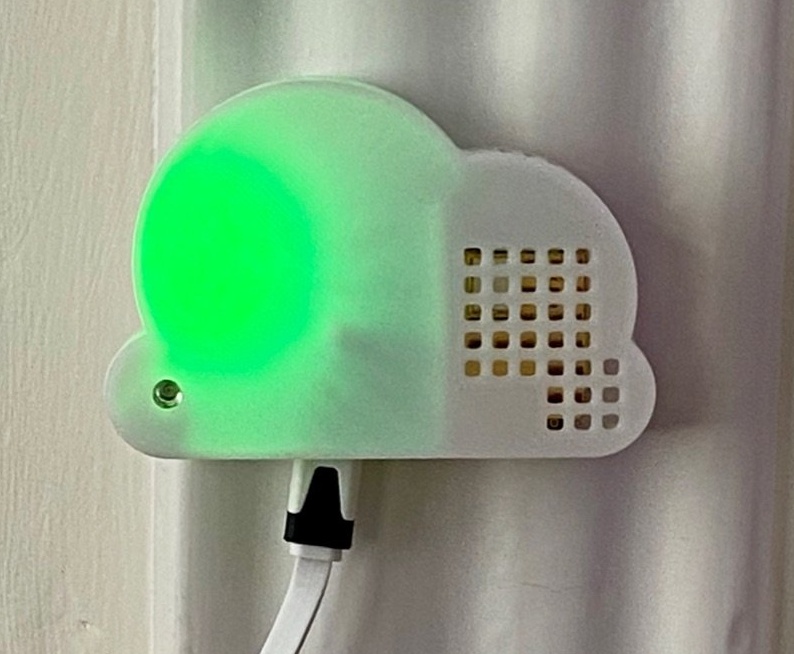
For the air quality of naturally ventilated (residential) rooms, the concentration of carbon dioxide in the indoor air is considered an indicator. Concentrations below 1000 ppm carbon dioxide in the room air are considered harmless, concentrations between 1000 and 2000 ppm are conspicuous and concentrations above 2000 ppm are [1] unacceptable.
Since the new coronavirus spreads to a large extent via aerosols and the CO2 concentration in enclosed spaces gives a good indication of the aerosol load, the need for ventilation can be recognized by CO2 measurement [2,3,4] .
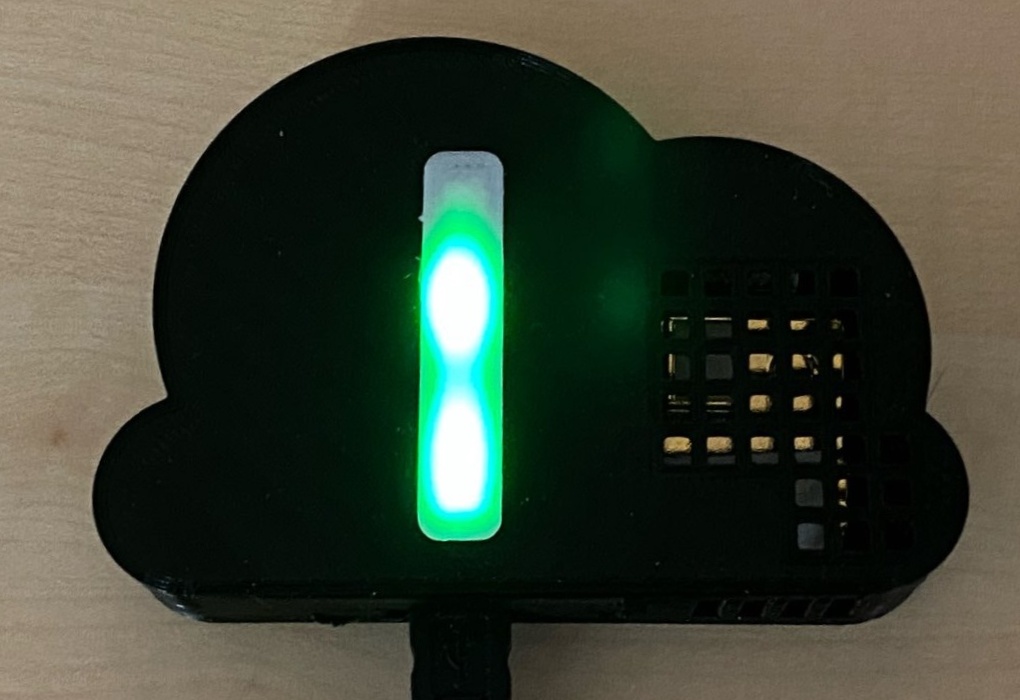
In the meantime, there are a number of CO2 measuring instruments and traffic lights on the market (see [5]). However, these are mostly closed systems, trapped in a (often Chinese) cloud and associated app, or do not provide CO2 readings but ratings of max. 1-5.
As a result, the plan quickly emerged to build a CO2 meter that can be integrated into the smart home and meets the following requirements.
requirements
- small and visually appealing (opinions in the family are often divided)
- Adjustable traffic light display, optional with acoustic warning
- Stand-alone operation and integration into the smart home with MQTT if possible.
- cheap
- little development and programming effort
After a short search, the choice was made for the following configuration.
Configuration
- ESP8266 in the form of a D1 Mini NodeMcu with ESP8266-12F WLAN module (approx. 5,–)
- Tasmota ‘operating system’ – contains out of the box everything you need, see https://www.tasmota.info/ (free) – alternatively ESPEasy would have been
- MH-Z19B – reliable CO2 sensor (approx. 35,-) – failed alternative is the CCS811, which is cheaper but does not provide reproducible or plausible results.
- WS2812 – 1-3 pieces RGB Led (< 1,–/Stück)
- Enclosure – made of 3D printer
- Minibuzzer – optional (approx. 1.50)
- IR-Led – optional for TV or air conditioning control (approx. 1,–)
- BMP280 – optional for measuring room temperature and air pressure (approx. 2,–)
The project in detail
sources
- O A. (2008). „Gesundheitliche Bewertung von Kohlendioxid in der Innenraumluft: Mitteilungen der Ad-hoc-Arbeitsgruppe Innenraumrichtwerte der Innenraumlufthygiene-Kommission des Umweltbundesamtes und der Obersten Landesgesundheitsbehörden“. doi: 10.1007/s00103-008-0707-2.
- Robert Koch Institute (2021). RKI Epidemiologischer Steckbrief zu SARS-CoV-2 und COVID-19; https://www.rki.de/DE/Content/InfAZ/N/Neuartiges_Coronavirus/Steckbrief.html
- Moriske et al., (2020). Das Risiko einer Übertragung von SARS-CoV-2 in Innenräumen lässt sich durch geeignete Lüftungsmaßnahmen reduzieren. Umweltbundesamt; https://www.umweltbundesamt.de/sites/default/files/medien/2546/dokumente/irk_stellungnahme_lueften_sars-cov-2_0.pdf
- Stoll, J. (2020). Infektiöse Aerosole in Innenräumen. Umweltbundesamt; https://www.umweltbundesamt.de/themen/gesundheit/umwelteinfluesse-auf-den-menschen/innenraumluft/infektioese-aerosole-in-innenraeumen
- O A. o. J. „Gesunde Luft – CO2-Messung als Indikator der Luftgüte“. ELV Elektronik Online Shop | Kompetent in Elektronik. Retrieved April 11, 2021 (https://at.elv.com/gesunde-luft-co2-als-indikator-der-luftguete).